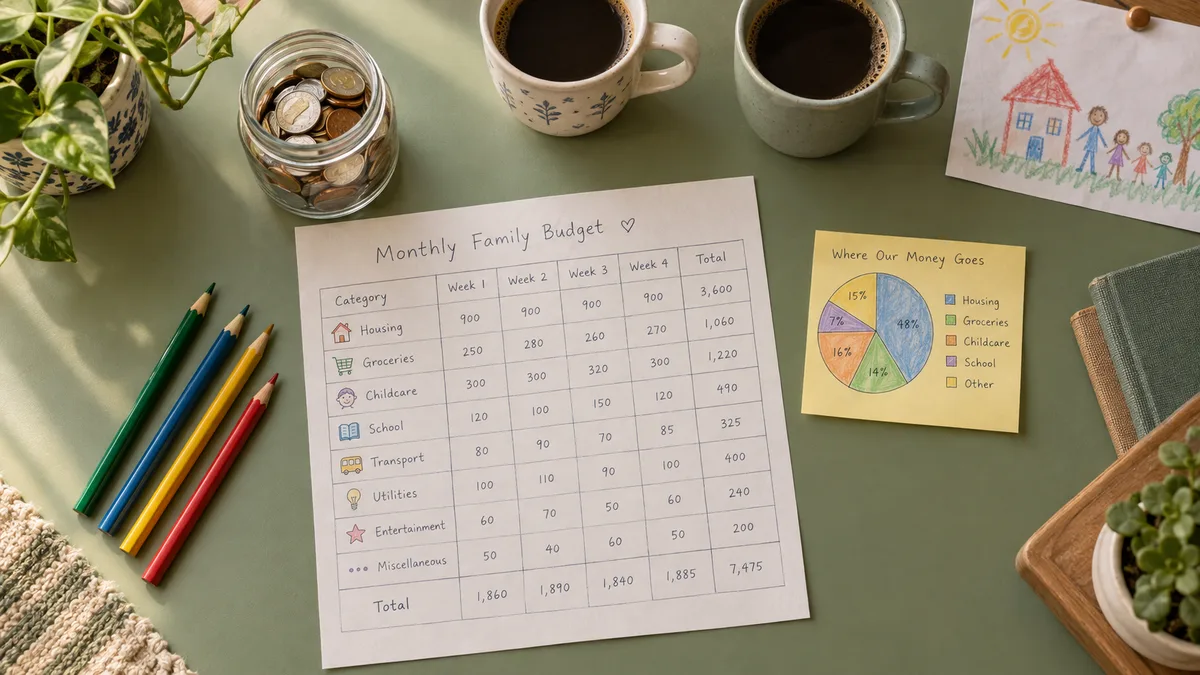
Budgeting advice is usually written for one adult with one payslip and predictable weeks. A family of four is none of that: two adults’ schedules, school terms that reset your spending four times a year, growth spurts that eat shoe budgets, and birthdays that somehow always cluster. A family budget is still a budget - the same income-minus-expenses logic - but it needs a few extra categories and a different rhythm. This guide builds one from scratch, with a worked example you can copy and adapt.
Two things make family budgeting different. First, more people means more small, frequent, unpredictable spending: one supermarket trip can be nappies, packed-lunch supplies, a birthday card and batteries in a single receipt. Second, kid costs are lumpy rather than steady. Nothing is spent on school for two months, then term starts and uniforms, shoes, fees and supplies land in the same fortnight.
A budget that treats every month as identical will break in September and at Christmas. The fix is not a more complicated spreadsheet - it is planning for the lumps on purpose, which is what most of this guide is about.
Start with the standard categories: housing, utilities, groceries, transport, insurance, debt payments, savings. Then add the ones family budgets forget: Childcare and school: fees, lunches, uniforms, supplies, trips, after-school clubs. Kids’ activities: sports, music lessons, swimming - each looks cheap alone and they compound quietly. Clothing and shoes: children outgrow things on a schedule that ignores your pay cycle. Medical and pharmacy: the dentist check-ups, the random Tuesday-night cough syrup. Gifts and occasions: birthdays (yours and the twelve classmates), holidays, teachers’ gifts. Family fun: the cinema trip, the takeaway Friday, the day out. If it has no line, it still gets spent - it just comes out of groceries.
That last list is where most family budgets leak. Not because the spending is wrong, but because it was never written down, so the total is always a surprise.
A sinking fund is a small monthly amount set aside for a cost you know is coming. School costs might be $600 a year - instead of absorbing that in one painful month, move $50 a month into a school pot. Christmas, birthdays, car insurance, the annual dentist round: each gets a small monthly line, and the big month becomes a non-event.
Five or six sinking funds of $25-75 a month will cover most of what used to ambush the budget. This single habit is the difference between a budget that survives a full year and one that dies at the first school term.
Here is a worked example. Take-home pay $5,500 a month, two school-age kids, renting. It is an illustration, not a prescription - your numbers will differ, the shape will not: Housing $1,550 (28%). Utilities $280 (5%). Groceries $850 (15%). Transport $400 (7%). Insurance and healthcare $320 (6%). Childcare and school $450 (8%). Kids’ activities $150 (3%). Clothing $120 (2%). Sinking funds $300 (5%). Debt payments $250 (5%). Savings $500 (9%). Family fun and personal $330 (6%). Total: $5,500.
Notice two things. The family-specific categories (childcare, activities, clothing, sinking funds) are $1,020 - nearly a fifth of income - which is why a budget copied from a single-adult template fails. And savings still exists, because it was written in first, not found at the end.
Food is usually the second-largest family expense after housing, and the one with the most room to move. For an outside benchmark, the US Department of Agriculture publishes monthly food plans at four cost levels (thrifty, low-cost, moderate, liberal) priced for a reference family of four - worth a look to sanity-check your own grocery line against an official estimate.
The practical levers are boring and effective: one main shop per week with a list, a meal plan that repeats the cheap winners, own-brand staples, and a rule that top-up trips happen with a list too. Families routinely cut 10-20% off the grocery line this way without eating worse - the savings come from waste and impulse, not from the meals.
With the categories written down, give each one a target. Percentage splits work well for families because they scale when income changes - the classic 50/30/20 (needs, wants, savings) is a decent first draft, though childcare-heavy years often push needs past 60% and that is a season, not a failure. We wrote a full guide to choosing and calculating your split, linked below.
Then protect the budget with a fifteen-minute monthly money meeting: same evening each month, both adults, one screen. Three questions: what did we plan, what actually happened, what changes next month. The meeting matters more than the tool - a family budget is a conversation that keeps happening, not a document written once.
A family budget lives or dies on whether checking it is easy. A spreadsheet with one column per category and a row per month does the job: drop in the real numbers at the end of the month, and a formula shows the difference from the plan per category. The sinking funds just get their own lines, growing month by month.
If you would rather start with the structure pre-built, our budget templates have income, category columns, sinking-fund lines, automatic totals and a monthly comparison chart already wired up. One copy link puts your private version in your Google account, and the first monthly check takes minutes.
It depends heavily on where you live and the children’s ages, but most US family-of-four budgets land somewhere in the $4,500-9,000 range for core costs, with housing and childcare as the swing factors. For a food-specific benchmark, the USDA publishes monthly food plans priced for a reference family of four at four cost levels.
A workable starting shape is 50-60% of take-home pay for needs (housing, utilities, groceries, transport, childcare), 20-30% for wants and family fun, and 10-20% for savings and extra debt payments - plus small monthly sinking funds for the lumpy costs like school terms, birthdays and holidays that otherwise break the plan.
Write down take-home income, list last month’s real spending by category (including the family ones: school, activities, clothing, gifts), set a target per category, and review actuals against targets in a 15-minute monthly meeting. Add sinking funds for irregular costs from month one.
Turn each irregular cost into a small monthly sinking fund. Divide the yearly amount (school costs, birthdays, Christmas, sports seasons) by twelve and set that aside each month. The big month then pays for itself.
One person can run the spreadsheet, but both should be at the monthly review. A budget one partner never sees becomes a list of surprises and arguments; fifteen minutes together each month is what keeps it honest.
choose your split with our budget percentages guide · the budget spreadsheet with sinking funds built in · a savings tracker for the family goals · a bi-weekly budget worksheet if payday is fortnightly

How to use Google Sheets from zero: cells, formulas, formatting and sharing, explained with small real examples. No jargon, no prior Excel needed.
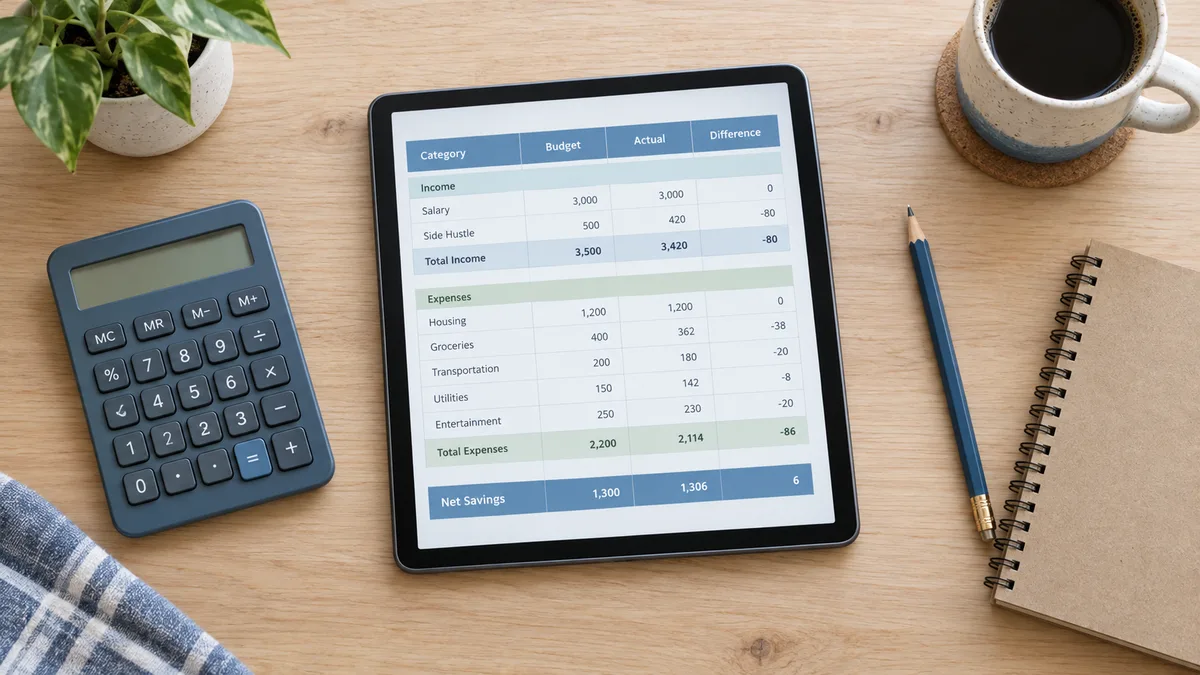
How to make a spreadsheet from a blank grid: plan the columns, add formulas, format it clean, and turn it into a reusable template. A 15-minute build.